Who are the heirs under Japanese laws.A Japanese inheritance lawyer explains who can receive inherited property.
Are you wondering, “Can I inherit? How much can I inherit?” This article explains in an easy-to-understand manner, the outlineabout inheritance, including the specific scope and order of those who can become heirs, the differences in inheritance with and without a will, and even cases where one cannot become an heir.
In conclusion, the spouse shall always be an heir, but there is a clear order of priority for other relatives, and some persons may inherit by will. In Japan, the statutory share of inheritance in the absence of a will is determined by the Civil Code. Furthermore, there is a right called the right to claim infringement of the statutory residual portion of inheritance, which cannot be infringed even if there is a will.
1. “Who can inheritin Japan and under Japanese law?”
Inheritance is a system in which specific persons succeed to the property, rights, and obligations of a deceased person, and in Japan, it is a right provided for in the Civil Code. When the decease is a Japanese, the Civil Code of Japan will be applicable for his or her inheritance.
First, we will explain the basic rules regarding who becomes an heir and the importance of role of Japanese inheritance lawyers.
1-1. Rules under the Civil Code on Who can inherit in Japan
In principle, those who become heirs are persons called “statutory heirs” as determined by the Civil Code of Japan. As an exception, if the decedent (the deceased Japanese person) left a valid will, the contents of the will take precedence and overrides the statutory heirs. The person designated to receive the estate under the will can inherit. In other words, persons other than statutory heirs may succeed to the property under the will.
Under the law, inheritance commences at the moment the decedent passes away, and the heir succeeds not only to the positive assets (savings, real estate, etc.) but also to the negative assets (debts, etc.) that the decedent held. However, procedures are necessary because one cannot succeed to the estate (inherited property) left behind without taking actions such as withdrawing bank deposits or changing the title of real estate in the public real estate registration system in Japan. For this purpose, lawyers specializing in inheritance provide necessary support for you.
The specific scope and order of those who can become heirs will be explained later. Before that, we will explain the provisions of the Civil Code and the fact that the presence or absence of a will are very important factors in identifying heirs.
1-2. The Role of Inheritance Experts
Inheritance procedures are wide-ranging, from investigating heirs to estate division negotiations and inheritance tax filing, and require specialized knowledge and a significant amount of time. In particular, when there are multiple heirs, when the inherited property includes real estate, or when the heirs cannot reach an agreement, the inheritance procedures are difficult to complete. In such cases, the involvement of inheritance lawyers is necessary even among Japanese heirs. Lawyers will act as legal representatives to complete negotiations and will file a petition for mediation with the family court to expedite resolution. This reduces the burden of procedures on heirs and enables faster inheritance.
2. Scope and Order of Statutory Heirs
In the absence of a will, who becomes an heir is determined by the Civil Code. These are called “”statutory heirs,”” and a strict order of priority is established. This order determines who has the right to inherit. First, we will explain the scope and order of these statutory heirs.
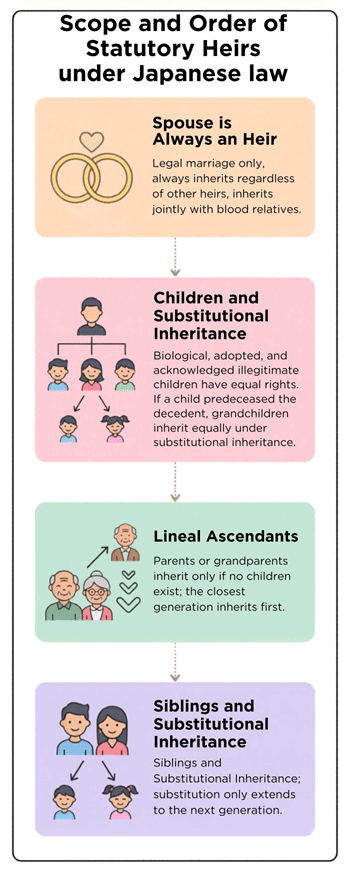
2-1. The Spouse Is Always an Heir
If the decedent (the deceased person) has a legal spouse, that spouse shall always be an heir. The spouse is always an heir regardless of what other heirs there may be. However, under the Japanese Civil Code, the spouse referred to here is only a person who is in a legal marriage relationship, and a partner in a common-law marriage relationship does not become a statutory heir.
The spouse inherits jointly with other blood relatives such as “children,” “lineal ascendants,” or “siblings.”
2-2. First-Priority:Children
The heirs who have priority after the spouse are children. They are called first-priority heirs.
If the decedent has children, biological children and adopted children through adoption become heirs. Furthermore, under the current Japanese Civil Code, illegitimate children (children born to unmarried parents who have been acknowledged) are also recognized as having equal inheritance rights as children.
If a child has died before the decedent, and that child has children (that is, grandchildren from the decedent’s perspective), those grandchildren become heirs in their place, and this system is called “substitutional inheritance.” If there are multiple such grandchildren, all of them become joint heirs by such legal substitutional inheritance system, and they inherit the original share together in equal proportions.
2-3. Second-Priority:Lineal Ascendants
If there are no first-priority children, the next persons to become heirs are second-priority “lineal ascendants.” Please note that if there are children, lineal ascendants do not become heirs. These are the parents or grandparents of the deceased person. Under the Japanese Civil Code, relatives of the ascending generation are called lineal ascendants, sonzoku in Japanese.
In this case, the lineal ascendants of the generation closest to the decedent become the heirs. Usually, these are the decedent’s parents. If both parents are alive, both become heirs. If one has passed away, the father or mother becomes the heir. If both parents have already passed away, the grandparents become the heirs. In other words, under the Civil Code of Japan, there is a rule that the order moves up this way.
2-4. Third-Priority : Siblings
Only when there are no first-priority children or second-priority lineal ascendants do third-priority “siblings” become heirs. If the decedent has multiple siblings, all of them become joint heirs.
The system of substitutional inheritance also applies to such siblings. If a sibling has died before the decedent, and that deceased sibling has children, those children inherit. In other words, the deceased person’s nephews and nieces become heirs. However, under the rules of the Civil Code of Japan, the substitutional inheritance for siblings extends only to the generation of the deceased person’s nephews and nieces. Substitutional inheritance does not extend to their children. Caution should be exercised on this point.
3. Inheritance When There Is a Will
In inheritance, the procedures differ significantly depending on whether the deceased (decedent) left a will. Who receives the property also differs. In Japan, it is not very common for wills to be left, but recently, holographic wills have been increasingly prepared. A will represents the final intentions of the decedent in a legally valid form. Under the Japanese Civil Code, there is a rule that the contents of a will take precedence over statutory inheritance.
3-1. When There Is No Will: Statutory Inheritance
If the deceased did not leave a will, the inheritance is succeeded to by statutory heirs as determined by the Civil Code. The shares will be the statutory shares of inheritance. In this case, an estate division negotiation where all heirs discuss how to divide the estate is necessary. If the estate division negotiation cannot be concluded, the inheritance procedures cannot proceed.
3-2. Designation of Heirs by Will
A will is prepared for the deceased to freely specify to whom and how to distribute their property. This enables the transfer of certain property to specific persons among the statutory heirs. Property can also be transferred to persons other than statutory heirs, such as common-law spouses, friends who provided care, or specific organizations. This is called a “bequest.” Persons designated in a will can receive property in accordance with its contents. However, under Japanese law, for a will to be legally valid, it must comply with the formalities prescribed by the Civil Code. The rules for holographic wills and notarial wills are determined by the Civil Code.

4. What Is a Claim for Infringement of Statutory Residual Portion
While a will respects the intentions of the deceased, certain statutory heirs are guaranteed a minimum share of inheritance under the Civil Code of Japan. This is the system called “statutory residual portion.” If the contents of a will infringe upon this statutory residual portion, the heir whose statutory residual portion was infringed can demand payment of money for the infringed portion from the heir or legatee who received property. This right is the right to make a claim for the amount of the infringed portion of the statutory residual portion of inheritance. The statutory residual portion is recognized for the spouse, children (including heirs by representation of such children), and lineal ascendants. Please note that siblings do not have a statutory residual portion. Since a claim for the amount of the infringed portion of the statutory residual portion of inheritance must be made within one year from the commencement of inheritance (or from when one became aware of it), make the claim promptly. If you have a lawyer who make this claim on your behalf, the subsequent inheritance procedures will proceed swiftly.
5. Cases Where One Cannot Become an Heir
In Japan, there are persons who lose their inheritance rights due to specific circumstances. Also, one can waive the right voluntarily. The following explains in what circumstances a person who was originally supposed to become an heir can no longer become an heir.
5-1. Persons Who Fall Under Disqualification from Inheritance
Disqualification from inheritance is a system where a person’s inheritance rights are automatically lost by operation of law when they commit specific illegal acts prescribed in the Civil Code. This is determined by law regardless of the intentions of the decedent. The main grounds for disqualification include the following acts.
- A person who was punished for intentionally causing or attempting to cause the death of the decedent, an heir with higher priority, or an heir of the same priority.
- A person who, despite knowing that the decedent was killed, did not make an accusation or complaint (except when that person was subject to fraud or duress).
- A person who, through fraud or duress, caused the decedent to make, revoke, or change a will.
- A person who has forged, altered, destroyed, or concealed a decedent’s will.
Persons who have committed these acts are deprived of their inheritance rights because they seriously harm the fairness of the inheritance system. Even if the decedent forgives a person who has been recognized as disqualified from inheritance, the inheritance rights will not be restored. However, if the disqualified person has children, those children may have the right to inherit as heirs by representation.
5-2. Persons Who Have Been Disinherited
Disinheritance is a system where the family court deprives an heir of inheritance rights based on the intentions of the decedent when the heir has abused, seriously insulted, or engaged in other serious misconduct toward the decedent. Disqualification from inheritance is a system where inheritance rights are automatically lost by Japanese law, but the implementation of disinheritance requires the intentions of the decedent and an adjudication by the family court.
Specific examples of misconduct subject to disinheritance include the following acts.
- Acts of prolonged physical abuse or causing mental anguish to the decedent.
- Acts of unlawfully taking or squandering the decedent’s property.
- Acts that significantly damage the decedent’s reputation.
- Criminal action which has caused significant harm to the decedent.
The decedent may file a petition with the family court during his/her lifetime or express the intention of disinheritance in a will. Even if the intention of disinheritance is expressed in a will, the executor must ultimately file a petition for a ruling on disinheritance with the family court. When disinheritance is approved, that heir loses his/her rights as an heir; however, similar to disqualification, if the disinherited person has children, those children may become heirs through representation.
5-3. Person who has Renounced Inheritance
Renunciation of inheritance means the expression of intention by an heir not to succeed to any of the property left by the decedent (including both positive and negative assets). This is when an heir voluntarily renounces his/her right of inheritance of his/her own will, and it becomes possible by making a statement to the family court. Our office also assists with making this statement.
The main reasons for choosing to renounce inheritance include the following cases.
- Cases where the decedent has significant debts or liabilities, and inheriting would result in assuming those obligations.
- Cases where there is an agreement among heirs to let specific heirs to have all property after inheritance.
- Cases where one does not want to be involved in inheritance procedures or wishes to avoid disputes with other heirs.
Renunciation of inheritance must be stated to the family court within three months (deliberation period) from the time the heir has knowledge that there has been a commencement of inheritance for him/her. Please be careful, as if this period passes, it will be deemed that the inheritance has been accepted, and renunciation will no longer be possible. When renunciation of inheritance is approved, that person shall be treated as not originally having been an heir. Therefore, substitutal inheritance does not occur, and the heir of the next rank becomes the heir.
6. Method of Investigation of Heirs
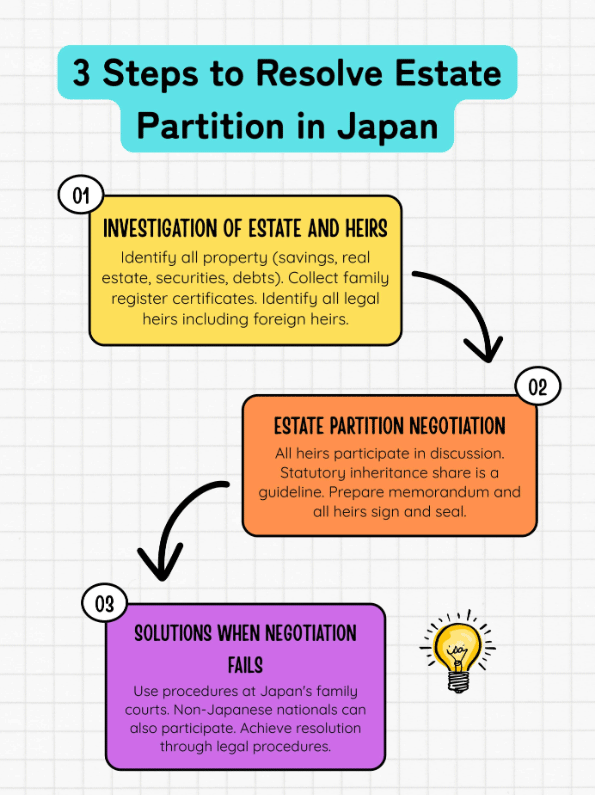
When inheritance commences, the first thing to do is to accurately identify who will be the heirs. The scope and order of heirs are determined by the Civil Code, but to actually confirm this, it is necessary to examine the family register of the decedent (the deceased person).
To do this, consecutive certified copies of the family register from the decedent’s birth to death are collected, and in Japan, attorneys can collect these by official authority once retained for a case. Not only the current certified copy of the family register, but also, as necessary, certified copies of removed registers and original family registers before revision will be collected. By tracing back through the family registers in this manner, facts such as acknowledged children and adoptions can be discovered. The family composition resulting from divorce or remarriage can also be understood. Family registers can be obtained from the municipal office where the decedent’s registered domicile was located, by heirs and their attorneys.
Once all family registers are collected, a diagram explaining the inheritance relationships will be prepared by the lawyers . This diagram illustrates who the statutory heirs are and complex inheritance relationships such as the occurrence of representation.
7. How to Proceed with Agreement for Division of Inherited Property
Once the investigation of heirs is complete and it is determined who the heirs are, the next thing to do is the agreement for division of inherited property. This refers to the process in which all heirs discuss how to divide the decedent’s estate (including both positive and negative assets) and aim to reach a consensus. This is conducted when there is no will, or when agreement for division of inherited property is necessary even if there is a will.
The agreement for division of inherited property requires the participation of all heirs and will not be established without the consent of all of them. If even one heir does not agree, the agreement will not be established and the estate cannot be divided, so a petition for mediation at the family court will be filed. Since prolonged discussions often do not lead to resolution, we recommend switching to filing for mediation if it appears that agreement cannot be reached within several months.
If you retain an attorney, the discussions can proceed without going to the family court, but since the family court requires all parties to participate in the discussions, it proceeds more quickly than discussions outside the court.
Normally the estate subject to agreement includes various items such as real estate, deposits and savings, securities, automobiles, and artwork, when there is substantial inherited property, support from the family court and attorneys will be essential for fair and quick division.
Once an agreement is reached, a written agreement for division of inherited property will be prepared to clarify its contents (note that if an agreement is reached through the Japanese court mediation, the mediation record will be prepared by the attorney and the court if an attorney has been retained). This document specifically states who will inherit which property, and all heirs sign, present their seal certificates, and affix their seals (when preparing a mediation record at the family court, seal certificates are not required). However, for heirs living overseas, since they do not have seal certificates, alternative measures are necessary. Seal certificates are necessary to prove that the seal impression belongs to the person.
The written agreement for division of inherited property and the mediation record are important documents used in subsequent inheritance procedures such as real estate registration and withdrawal of deposits and savings.
8. Importance of Consulting Experts
Inheritance procedures require extensive legal knowledge and tax filings.
For calculation and filing of inheritance tax, it will be necessary to engage a certified tax accountant. And in cases where there is substantial inherited property, many heirs, or heirs living overseas, the agreement for division of inherited property often cannot be reached quickly among parties, so in such cases, please consult an experienced Japanese attorney. The benefits of consulting such an attorney are not limited to having procedures handled on your behalf; by receiving appropriate advice even in complex situations, resolution is expedited. Additionally, by reducing the mental burden of negotiations, you can proceed with inheritance procedures with peace of mind.
9. Summary
The matter of “who can inherit” is prescribed in the Civil Code of Japan. When there is a will, those rules are not used, and inheritance proceeds according to the will.
Inheritance is an important procedure for passing on inherited property to the next generation. It is important to understand what rights you have with legal knowledge.
To achieve smooth inheritance, it is desirable to consult an attorney early and understand what method is best for your situation.
