Japan Inheritance Mediation: Complete Guide to Family Court Disputes, Required Documents, and Adjudication
By Eriko Matsuno, Attorney at Law — Tokyo J Law Office
When heirs cannot agree on how to divide an estate in Japan, Inheritance Mediation (Isan Bunkatsu Chōtei) offers a formal legal path to resolution through the Family Court. For many people—especially those living overseas or unfamiliar with Japan’s legal system—navigating court procedures can feel intimidating.
This guide walks you through the entire mediation process from a veteran Japanese attorney’s perspective, covering how to gather required documents, what to expect during court sessions, how overseas heirs can participate remotely, and when a case transitions to formal adjudication.
Contents
- Understanding Inheritance Mediation and Adjudication in Japan
- How Family Court Mediation Works (Diagram)
- Filing for Mediation: Jurisdiction, Costs, and Required Documents
- 3.1 Choosing the Right Family Court and Filing Fees
- 3.2 Obtaining the Deceased’s Family Registry (Koseki) from Birth to Death
- 3.3 Additional Documents for Grandchildren or Siblings as Heirs
- Inside Mediation Sessions: How the Process Works
- Key Strategies for a Favorable Outcome
- Concluding Mediation and the Legal Force of a Settlement
- When Mediation Fails: Moving to Estate Adjudication
- Special Notes for Heirs Living Outside Japan
- Frequently Asked Questions (FAQ)
1. Understanding Inheritance Mediation and Adjudication in Japan
When private negotiations among heirs reach an impasse, the Japanese Family Court provides two structured mechanisms for resolution: mediation and adjudication.
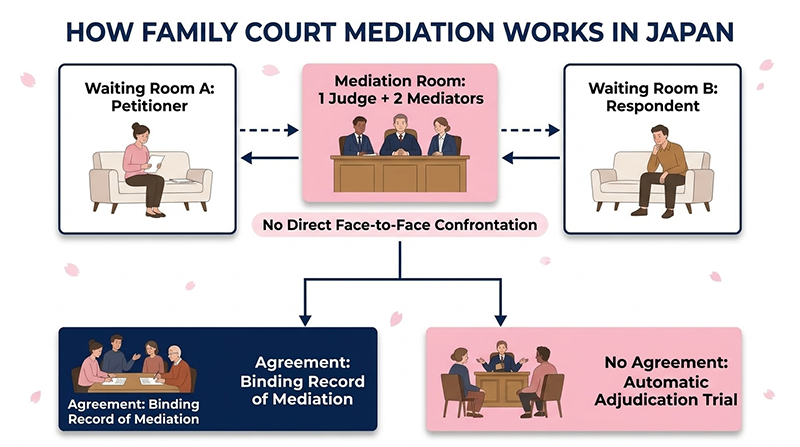
Inheritance Mediation (Isan Bunkatsu Chōtei) is a court-supervised negotiation process aimed at helping heirs reach a voluntary, amicable agreement. Unlike a traditional trial, a judge does not impose a ruling. Instead, a Mediation Committee—consisting of one judge and two or more court-appointed mediators (chōtei iin, selected from attorneys and other qualified specialists)—acts as a neutral intermediary. Having third-party professionals facilitate the discussion helps cool emotional tensions and encourages practical, rational compromise.
Inheritance Adjudication (Isan Bunkatsu Shinpan), by contrast, is a binding legal proceeding that takes over if mediation fails to produce an agreement. While mediation relies on dialogue, adjudication results in a court-ordered decision. A Family Court judge evaluates the facts and legally determines how the estate will be divided. Because the judge holds final decision-making power, the outcome may not align with what either party hoped for.
2. How Family Court Mediation Works
One distinctive feature of Japanese Family Court mediation is that heirs almost never meet face-to-face. Instead, the petitioner and the opposing parties wait in separate waiting rooms and take turns entering the mediation room to speak privately with the mediators.
3. Filing for Mediation: Jurisdiction, Costs, and Required Documents
Proper preparation before filing is essential to keep your case moving smoothly through the Japanese Family Court system.
3.1 Choosing the Right Family Court and Filing Fees
As a general rule, you must file your petition with the Family Court that has jurisdiction over the other party’s (the respondent’s) residential address. If there are multiple heirs living in different locations, you may file at a court convenient for the petitioner, or at any Family Court mutually agreed upon by all parties (“jurisdiction by agreement”).
Court filing fees in Japan are modest and paid using stamps:
- Revenue stamps (shūnyū inshi): ¥1,200 per decedent/estate.
- Postage stamps: Used by the court to mail notices to all parties (exact amounts vary by courthouse).
Along with the main petition, you must submit duplicate copies for every opposing heir.
3.2 Obtaining the Deceased’s Family Registry (Koseki) from Birth to Death
Unlike countries that rely on separate birth, marriage, and death certificates, Japan tracks family lineage through an official Family Registry (Koseki Tōhon). To file for inheritance mediation, you must submit a complete, unbroken set of the deceased’s family registries from birth until death. This allows the court to verify every legal heir with certainty.
If the deceased moved their registered domicile (honseki) several times, or had previous marriages or divorces, you will need to collect older records—known as removed family registries (joseki tōhon) and revised original registries (kaisei gen-koseki tōhon)—from multiple municipal offices across Japan. If you retain a Japanese attorney, they can obtain all required koseki records on your behalf.
3.3 Additional Documents for Grandchildren or Siblings as Heirs
- Inheritance by Representation (Daishū Sōzoku): If one of the deceased’s children passed away earlier and their children (the deceased’s grandchildren) inherit in their place, you must provide current family registries for all inheriting grandchildren in addition to the deceased’s complete records.
- Siblings as Heirs: If the deceased had no children and their parents and grandparents are also deceased, the deceased’s siblings become the legal heirs. You must obtain the deceased’s parents’ family registries from birth to death to confirm whether any half-siblings exist.
Standard municipal issuance fees are ¥450 per current family registry and ¥750 per removed or revised original registry.
4. Inside Mediation Sessions: How the Process Works
- First Hearing: The mediators review the basic facts of the estate, confirm the list of heirs and assets, and listen to each side’s initial proposals. Submitting a clear written brief (shuchō shomen) in advance helps the mediators grasp your legal position immediately.
- Subsequent Hearings & “Homework”: Each session lasts roughly two hours and takes place once every 1 to 2 months. Between sessions, the Mediation Committee typically assigns tasks—such as gathering bank statements, obtaining real estate appraisals, or responding to the other party’s claims.
- Communicating Effectively: Mediators remain strictly neutral. Staying calm, supporting your claims with objective documents rather than emotional accusations, and proposing realistic compromises are key to winning the committee’s trust.
5. Key Strategies for a Favorable Outcome
- Organize Core Legal Issues: Clarify disputes involving Special Benefits (Tokubetsu Jueki) (lifetime gifts received by an heir) or Contributory Portions (Kiyobun) (special caregiving or financial contributions).
- Submit Written Briefs and Objective Evidence: If another heir is hiding bank records, your attorney can request a court-ordered bank inquiry (chōsa shokutaku) to obtain statements directly from financial institutions.
- Prepare with Adjudication in Mind: Every document and statement submitted during mediation stays in the court file if the case moves to adjudication. Maintain a consistent, legally grounded position from day one.
6. Concluding Mediation and the Legal Force of a Settlement
When all heirs reach an agreement, the Family Court drafts an official Record of Mediation (Chōtei Chōsho). This public document carries the exact same legal force as a final court judgment:
- Unilateral Bank & Real Estate Transfers: You can withdraw inherited funds from Japanese banks and transfer real estate titles on your own by presenting the Record of Mediation—without needing the other heirs’ signatures or registered seals.
- Right to Compulsory Execution: If another heir fails to pay an agreed settlement sum, you can petition the court to seize their assets.
7. When Mediation Fails: Moving to Estate Adjudication
If negotiations remain deadlocked, the Mediation Committee terminates mediation as “unsuccessful” (fuseiritsu), and the case automatically transitions to Inheritance Adjudication (Isan Bunkatsu Shinpan) without needing a new petition.
A Family Court judge reviews all evidence and issues a binding Written Adjudication Decision (Shinpan-sho) strictly based on Japan’s Civil Code. If you disagree with the decision, you have only two weeks from the day after formal service to file an immediate appeal (sokuji kōkoku) with the High Court.
8. Special Notes for Heirs Living Outside Japan
- No Need to Travel to Japan: Overseas heirs represented by a Japanese attorney can attend mediation sessions via Zoom/Teams video conferencing or telephone, avoiding costly international flights.
- Signature Certificate (Sain Shōmei): Where Japanese residents use a registered seal (Inkan), overseas residents can use a Signature Certificate and Certificate of Residence (Zairyū Shōmei) issued by a Japanese embassy/consulate or local Notary Public.
- Foreign-National Heirs: If an heir does not hold Japanese citizenship and has no Koseki, certified birth/marriage certificates or notarized affidavits with Japanese translations are used to prove family relationships.
For a broader overview of Japanese inheritance rules, see our Complete Guide to Japan Inheritance Law.
About the Author & Reviewer
Eriko Matsuno, Attorney at Law — Tokyo J Law Office Last Updated: November 2026
With over 25 years of legal experience, including a decade at one of Japan’s prestigious “Big Four” law firms, Attorney Eriko Matsuno specializes in complex domestic and cross-border family law, international inheritance, and high-net-worth asset division. She is a recognized contributor to the globally respected International Comparative Legal Guides (ICLG).
Need help with a Japanese inheritance? Our office provides free initial consultations regarding Japanese inheritance matters for heirs living inside and outside of Japan (online consultations via Zoom/Teams available). ➡️ Contact Us for a Free Consultation
Frequently Asked Questions (FAQ)
A: Simple cases may settle in 3 to 6 months (2 to 4 sessions), while complex disputes involving real estate valuations, lifetime gifts, or hidden bank withdrawals typically take 1 to 2 years.
A: No. Japanese Family Courts use separate waiting rooms, and each party enters the mediation room separately to speak with the mediators, preventing direct confrontation.
A: Mediation requires voluntary participation, so if an heir refuses to appear or negotiate, the court will close mediation as unsuccessful and automatically move the case to Adjudication, where the judge will issue a binding ruling even without that heir’s consent.
