Renouncing an Inheritance in Japan (Sōzoku Hōki): The Strict 3-Month Deadline and Rules for Overseas Heirs
By Eriko Matsuno, Attorney at Law — Tokyo J Law Office
When a family member passes away in Japan, you do not only inherit their positive assets like bank accounts and real estate. Under Japanese law, heirs automatically inherit all liabilities as well—including bank loans, unpaid taxes, joint guarantor obligations, and even unwanted, dilapidated rural properties (Akiya).
If the deceased’s debts exceed their assets, or if you simply wish to avoid being entangled in complex family estate disputes, Japan offers a legal procedure called Inheritance Renunciation (Sōzoku Hōki).
However, this procedure comes with a strict 3-month deadline and rigid rules. For heirs living overseas, navigating this process from afar requires extreme caution. This guide explains what you need to know to safely renounce an inheritance in Japan, how to extend your deadline, and the fatal mistakes you must avoid.
Contents
- What is Inheritance Renunciation (Sōzoku Hōki)?
- The Strict 3-Month Deadline (Timeline)
- Deadline Extensions for Heirs Living Abroad
- The “Statutory Simple Acceptance” Trap: Actions to Avoid
- What is Limited Acceptance (Gentei Shōnin)?
- Why Consult a Japanese Inheritance Lawyer?
- Frequently Asked Questions (FAQ)
1. What is Inheritance Renunciation (Sōzoku Hōki)?
In Japan, Inheritance Renunciation (Sōzoku Hōki) is a formal legal procedure filed with the Japanese Family Court. Once approved, you are legally considered to have never been an heir from the beginning. You will receive absolutely none of the deceased’s assets, but you will also be completely freed from all of their debts and liabilities.
⚠️ Crucial Warning: Private Agreements Do NOT Protect You from Creditors Many people mistakenly believe that signing a private “Estate Partition Agreement” (Isan Bunkatsu Kyōgisho) stating “I will not inherit anything” is the same as renouncing. It is not. A private agreement only binds the heirs among themselves; banks and creditors can still legally demand payment from you. To escape debt, you must file a formal declaration of renunciation with the Family Court.
2. The Strict 3-Month Deadline
Under the Japanese Civil Code, you have only three months to decide whether to accept or renounce your inheritance. This 3-month period begins from the day you learn that the inheritance has commenced for you (typically the day you learn of the deceased’s death, or the day you learn that a prior heir has renounced, making you the next in line).
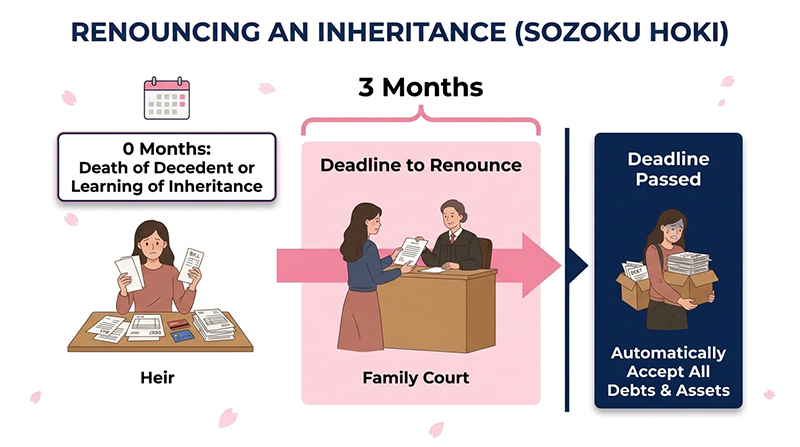
If you fail to file the proper paperwork with the Family Court within this 3-month window, the law presumes that you have unconditionally accepted the inheritance—including all debts (called “Simple Acceptance” or Tanjun Shōnin).
3. Deadline Extensions for Heirs Living Abroad
For heirs living outside Japan, three months is rarely enough time to collect the required historical Family Registries (Koseki), investigate the deceased’s assets and debts, and handle international mail.
Fortunately, it is possible to file a Petition for Extension of the Period for Acceptance or Renunciation (Jukuryō Kikan Shinchō no Mōshitate) with the Japanese Family Court.
- Crucial Rule: This extension request must be filed before the original 3-month deadline expires.
- An experienced Japanese attorney can file this extension immediately on your behalf, typically securing an additional 1 to 3 months to investigate the estate properly without risking automatic acceptance of debt.
4. The “Statutory Simple Acceptance” Trap: Actions to Avoid
Even if you are within the 3-month deadline, certain actions can instantly void your right to renounce. Under Article 921 of the Japanese Civil Code, if you dispose of or use the deceased’s property as your own, it is deemed a “Statutory Simple Acceptance” (Hōtei Tanjun Shōnin), locking you into inheriting everything—debts included.
If you plan to renounce, NEVER do the following:
- Do not withdraw or spend the deceased’s money: Even using the deceased’s own bank account funds to pay off their medical bills or loans can be treated as an act of acceptance.
- Do not sell, discard, or give away their property: This includes real estate, vehicles, jewelry, or valuable personal belongings.
- Do not sign an Estate Partition Agreement: Signing an Isan Bunkatsu Kyōgisho legally confirms your status as an accepting heir.
If you are unsure whether an action will trigger Simple Acceptance (for example, paying modest funeral expenses out of your own pocket), consult a Japanese lawyer before touching any part of the estate.
5. What is Limited Acceptance (Gentei Shōnin)?
While Sōzoku Hōki is an all-or-nothing renunciation, Japan offers a middle-ground option known as Limited Acceptance (Gentei Shōnin).
Under Limited Acceptance, you inherit the deceased’s debts only up to the value of the positive assets you inherit. For example, if the deceased left ¥10 million in cash but ¥50 million in debt, you use the ¥10 million to pay creditors and are legally cleared of the remaining ¥40 million deficit.
While this sounds ideal, Limited Acceptance is rarely used in practice due to three major hurdles:
- Unanimous Consent Required: Unlike full renunciation (which each heir can file individually), Limited Acceptance requires all legal heirs to file jointly. If even one heir refuses or has already triggered Simple Acceptance, this option is off the table.
- Complex Liquidation Process: It involves appointing an estate administrator, liquidating assets (often through court auctions), and formally notifying all creditors.
- Strict 3-Month Deadline: The unanimous filing must also be completed within the 3-month window.
6. Why Consult a Japanese Inheritance Lawyer?
Handling a Family Court filing in Japan while living abroad is daunting, especially when a single procedural mistake can leave you saddled with someone else’s debt. By retaining a Japanese attorney:
- No Travel to Japan Required: Your lawyer acts as your legal representative, handling all court filings, Japanese court inquiry letters (Shōkaisho), and communications while you remain in your home country.
- Document Procurement: Your lawyer retrieves the necessary historical Koseki registries from Japanese municipal offices on your behalf.
- Immediate Deadline Protection: Your lawyer can file for a 3-month deadline extension right away if debts are still being investigated.
For an overview of the entire inheritance system, see our Complete Guide to Japan Inheritance Law.
About the Author & Reviewer
Eriko Matsuno, Attorney at Law — Tokyo J Law Office Last Updated: November 2026
With over 25 years of legal experience, including a decade at one of Japan’s prestigious “Big Four” law firms, Attorney Eriko Matsuno specializes in complex domestic and cross-border family law, international inheritance, and high-net-worth asset division. She is a recognized contributor to the globally respected International Comparative Legal Guides (ICLG).
Need help with a Japanese inheritance? Our office provides free initial consultations regarding Japanese inheritance matters for heirs living inside and outside of Japan (online consultations via Zoom/Teams available). ➡️ Contact Us for a Free Consultation
Frequently Asked Questions (FAQ)
A: Yes. Overseas residents without a registered Japanese seal can substitute a “Signature Certificate” (Sain Shōmei) issued by a Japanese embassy or consulate, or a notarized affidavit from a local Notary Public. A Japanese lawyer will guide you through the exact format required by the court.
A: No. When you formally renounce through the Family Court, you are treated as never having been an heir, so your inheritance rights do not pass down to your children. However, inheritance rights do shift to the next priority class of heirs (such as the deceased’s parents or siblings), so you should notify them promptly so they can also renounce if needed.
A: In principle, yes. However, under Japanese Supreme Court precedent, if you genuinely had no knowledge of the debt and had justifiable reasons for not knowing (such as having had no contact with an estranged relative for decades), the Family Court may accept a late renunciation calculated from the day you received a creditor’s notice. Because this requires specialized legal arguments, consult a Japanese attorney immediately.
