Hidden Assets and Unaccounted Funds in Japan Inheritance Disputes: How a Lawyer Investigates Bank Records
By Eriko Matsuno, Attorney at Law — Tokyo J Law Office
One of the most distressing situations for an heir living overseas is discovering that a parent’s Japanese bank account—which should have held tens of millions of yen—is nearly empty upon their passing. Often, a relative who lived near the parent and managed their passbook (Tsūchō) and cash card withdrew large sums in the final years of the parent’s life, claiming the money was spent on “living expenses” or “caregiving.”
When you live outside Japan, you may feel powerless to verify what actually happened. You are not powerless. Under Japanese law, a licensed attorney (Bengoshi) has powerful statutory investigative tools that ordinary individuals—and even administrative scriveners (Gyōseishoshi) or judicial scriveners (Shihōshoshi)—cannot use.
This guide explains how a Japanese lawyer investigates hidden assets, pulls up to 10 years of historical bank records, and legally recovers misappropriated inheritance funds.
Contents
- Common Signs of Misappropriated Funds or Hidden Assets
- Why You Need a Licensed Japanese Attorney (Bengoshi) for Investigations
- How a Lawyer Investigates Bank Accounts (4-Step Process)
- Legal Remedies to Recover Unaccounted Withdrawals
- Why Early Action Matters (Bank Retention Limits & Statutes of Limitations)
- Frequently Asked Questions (FAQ)
1. Common Signs of Misappropriated Funds or Hidden Assets
Suspicions of financial misconduct frequently arise in cross-border inheritance cases when:
- A sibling or relative living in Japan refuses to show the deceased’s bank passbooks (Tsūchō) or transaction histories.
- Large, round-number ATM withdrawals (e.g., ¥500,000 per day) occurred repeatedly while the parent was hospitalized or suffering from severe dementia.
- Significant funds were transferred out of the parent’s account shortly before or immediately after the date of death.
- You suspect the deceased held accounts at major Japanese banks (MUFG, SMBC, Mizuho, Japan Post Bank) or securities firms that another heir has omitted from the estate inventory.
2. Why You Need a Licensed Japanese Attorney (Bengoshi) for Investigations
In Japan, strict legal boundaries separate different legal professions. While judicial scriveners (Shihōshoshi) and administrative scriveners (Gyōseishoshi) handle routine paperwork when all heirs agree, they are strictly prohibited by law from representing you in contested inheritance disputes or issuing formal attorney inquiries.
Only a licensed Japanese attorney (Bengoshi) can:
- Issue Bar Association Inquiries (Bengoshikai Shōkai / Article 23 Inquiries) compelling banks and financial institutions to disclose account balances and historical transaction logs.
- Petition the Family Court for Court-Ordered Document Inquiries (Chōsa Shokutaku) during Inheritance Mediation.
- File civil lawsuits in the District Court to demand the return of stolen or unauthorized funds.
3. How a Lawyer Investigates Bank Accounts (4-Step Process)
When you retain a Japanese inheritance lawyer, you do not need to fly to Japan to visit bank branches in person. Your attorney executes a structured investigation remotely:
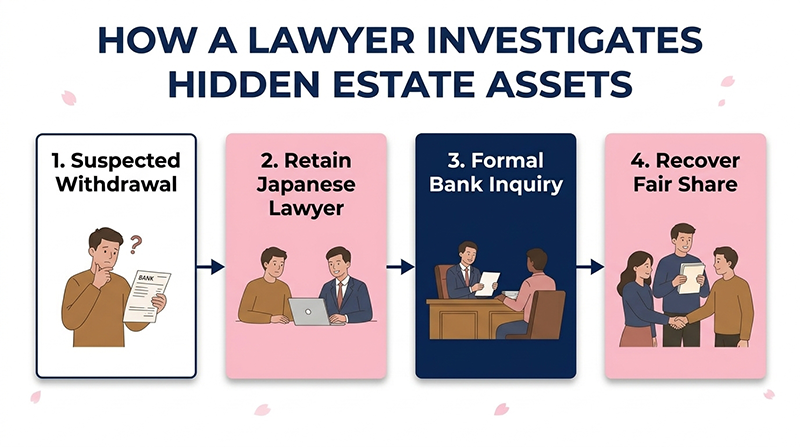
- Identify Target Financial Institutions: Based on clues from mail, tax notices, utility bills, or known banking habits, your lawyer identifies potential banks, credit unions, and securities firms.
- Request Full Transaction Histories (Up to 10 Years): As an heir’s legal representative, your lawyer requests complete transaction ledgers (Torihiki Rireki) going back up to 10 years prior to death.
- Cross-Check Medical & Care Records: Your lawyer compares the dates and locations of suspicious withdrawals against the parent’s hospitalization records and nursing care certifications (Yōkaigo Nintei) to prove the parent could not physically have made the withdrawals themselves.
- Demand Accounting & Recover Your Share: Armed with objective bank logs, your lawyer confronts the responsible heir in negotiation, mediation, or litigation.
4. Legal Remedies to Recover Unaccounted Withdrawals
Depending on when and how the money was taken, Japanese law provides distinct legal mechanisms to recover your fair share:
- Before Death (Without the Parent’s Consent): If a relative withdrew money without the parent’s authorization (or while the parent lacked mental capacity due to dementia), the parent held a claim against that relative for Unjust Enrichment (Futō Ritoku Henkan Seikyū) or Tort Damages (Fuhō Kōi). Upon death, you inherit your statutory share of that monetary claim and can sue the relative in District Court to recover it.
- Before Death (With the Parent’s Consent): If the parent voluntarily gave the money to the sibling, it may be treated as a Special Benefit (Tokubetsu Jueki) during Estate Partition—or challenged under Forced Heirship (Iryūbun) rules if it infringed your minimum legal share.
- After Death: Withdrawing funds from a deceased person’s bank account without unanimous consent from all heirs is an unlawful infringement of co-owned estate property, allowing you to demand immediate restitution.
5. Why Early Action Matters
Japanese banks are generally required by law to retain transaction records for 10 years. Every month you wait means older bank records permanently roll off the bank’s system and become unrecoverable. Furthermore, claims for unjust enrichment or tort damages are subject to strict statutes of limitations (typically 3 to 5 years from discovery, or 10 to 20 years from the act).
If something about your parent’s estate in Japan does not add up, acting swiftly is the only way to preserve the financial trail.
See also: Complete Guide to Japan Inheritance Law | Japan Inheritance Mediation Guide
About the Author & Reviewer
Eriko Matsuno, Attorney at Law — Tokyo J Law Office Last Updated: November 2026
With over 25 years of legal experience, including a decade at one of Japan’s prestigious “Big Four” law firms, Attorney Eriko Matsuno specializes in complex domestic and cross-border family law, international inheritance, and high-net-worth asset division. She is a recognized contributor to the globally respected International Comparative Legal Guides (ICLG).
Need help with a Japanese inheritance? Our office provides free initial consultations regarding Japanese inheritance matters for heirs living inside and outside of Japan (online consultations via Zoom/Teams available). ➡️ Contact Us for a Free Consultation
Frequently Asked Questions (FAQ)
A: Yes. Under Japanese Supreme Court precedent, any single legal heir has an independent right to request the deceased’s past transaction history from a bank without needing consent from co-heirs. Retaining a Japanese lawyer makes this process seamless, especially when you live overseas.
A: A Japanese attorney can conduct a targeted search across major Japanese financial institutions (such as MUFG, SMBC, Mizuho, Resona, and Japan Post Bank) as well as local banks near your parent’s residence using Bar Association Inquiries (Bengoshikai Shōkai).
A: Japanese courts place the burden of explanation on the person who managed the account. Ordinary living expenses for an elderly person in Japan rarely justify millions of yen in unexplained cash withdrawals. Without receipts or clear proof that the money benefited the parent, courts routinely order the sibling to return the unaccounted funds.
