Special Benefits in Japan Inheritance (Tokubetsu Jueki): How Lifetime Gifts Affect Estate Division
By Eriko Matsuno, Attorney at Law — Tokyo J Law Office
In many families, one child receives substantial financial support while their parents are alive—such as money to buy a home, capital to start a business, or funding for expensive overseas education—while another sibling receives little or nothing. When the parents pass away, dividing the remaining bank balance 50/50 often feels deeply unfair.
Japanese inheritance law addresses this exact issue through the doctrine of Special Benefits (Tokubetsu Jueki). By treating major lifetime gifts as an “advance” on that heir’s inheritance, the law allows other heirs to adjust the final split so everyone receives a truly fair share.
This guide explains what qualifies as a Special Benefit in Japan, how the “bring-back” calculation (Mochimodoshi) works, and how heirs living abroad can uncover and prove hidden lifetime gifts.
Contents
- What is a Special Benefit (Tokubetsu Jueki)?
- Examples: What Counts vs. What Does Not Count
- How the Calculation Works (Mochimodoshi Bring-Back Formula)
- When a Parent Waives the Bring-Back (Mochimodoshi Menjo)
- How Overseas Heirs Can Investigate Past Gifts
- Frequently Asked Questions (FAQ)
1. What is a Special Benefit (Tokubetsu Jueki)?
Under Article 903 of the Japanese Civil Code, if a legal heir received a bequest (Izō) or a substantial lifetime gift (Zōyo) from the deceased for marriage, adoption, or as capital for livelihood (Seikei no Shihon), that benefit is treated as a Special Benefit (Tokubetsu Jueki).
Rather than ignoring past transfers, Japanese courts add the value of those lifetime gifts back into the estate on paper, calculate each heir’s fair share of the combined total, and deduct the advance gift from the recipient’s share.
2. Examples: What Counts vs. What Does Not Count
Not every gift from a parent qualifies as a Special Benefit. Japanese Family Courts distinguish between ordinary parental generosity and substantial wealth transfers:
- Generally Considered Special Benefits (Tokubetsu Jueki):
- Down payments or funds to purchase a house or condominium
- Transfer of real estate or company shares during the parent’s lifetime
- Seed money or loans forgiven to start a business
- Extraordinary educational expenses (e.g., private medical school or overseas university tuition) that far exceeded what other siblings received
- Large cash transfers clearly intended to build the recipient’s assets
- Generally NOT Considered Special Benefits:
- Ordinary living allowances or modest seasonal gifts (Oseibo, Otoshidama)
- Standard wedding ceremony expenses within normal social norms
- Basic high school or standard university tuition provided equally to all children
- Life insurance payouts (Seimei Hoken-kin) in principle (unless the payout is so disproportionately massive compared to the total estate that ignoring it would be grossly unfair)
3. How the Calculation Works (Mochimodoshi Bring-Back Formula)
To calculate fair shares, the value of the Special Benefit is brought back (Mochimodoshi) into the estate at its present value at the time of inheritance (not the historical value when gifted).
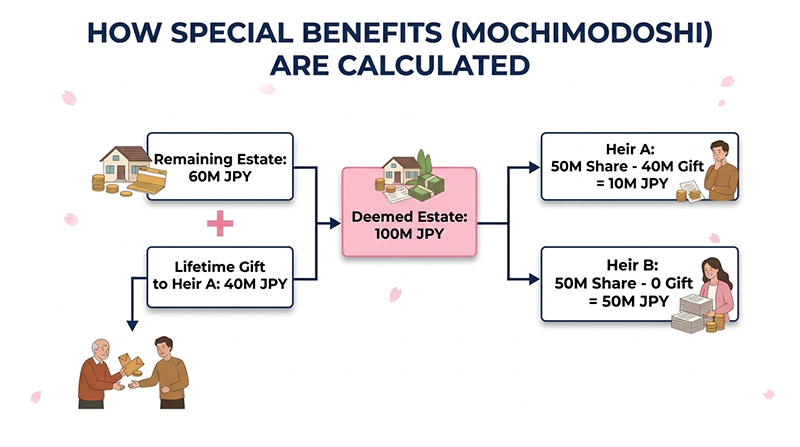
Step-by-Step Example (Two Children: Heir A and Heir B):
- Remaining Estate at Death: ¥60,000,000
- Lifetime Housing Gift to Heir A: ¥40,000,000
- Deemed Estate (Minashi Sōzoku Zaisan): ¥60M + ¥40M = ¥100,000,000
- Each Child’s Base Share (50%): ¥50,000,000
- Final Distribution:
- Heir A: ¥50M base share − ¥40M already received = ¥10,000,000 from the remaining estate.
- Heir B: ¥50M base share − ¥0 received = ¥50,000,000 from the remaining estate.
(Note: Even if Heir A’s lifetime gift exceeded ¥50M, Heir A does not have to pay cash back to Heir B during ordinary estate partition—unless the gift violated Heir B’s Forced Heirship (Iryūbun).)
4. When a Parent Waives the Bring-Back (Mochimodoshi Menjo)
A parent can legally instruct that a lifetime gift not be deducted from an heir’s inheritance—known as a Declaration of Exemption from Bring-Back (Mochimodoshi Menjo no Ishihyōji).
- If stated clearly in a valid will, the gift is excluded from the partition calculation (though it may still be challenged if it violates Forced Heirship).
- Spousal Residence Protection: Under Japanese law, if a couple was married for 20 years or more and one spouse gifted or bequeathed their marital home to the surviving spouse, the law presumes the deceased intended to exempt that home from Special Benefit deductions.
5. How Overseas Heirs Can Investigate Past Gifts
When you live outside Japan, it is common to suspect that a sibling living near your parents received large sums of money over the years—without having bank statements in hand.
A Japanese attorney can help uncover Special Benefits by:
- Obtaining 10 Years of Japanese Bank Records: Using formal Bar Association Inquiries (Bengoshikai Shōkai) or Family Court Document Inquiries (Chōsa Shokutaku), your lawyer can pull historical bank statements showing large outgoing transfers to a sibling.
- Checking Real Estate Registry Histories: Tracing past title transfers (Tōki Jikō Shōmeisho) to see if land or property was gifted prior to death.
- Presenting Strategic Briefs in Mediation: Organizing financial timelines clearly for the Family Court Mediation Committee so the burden shifts to the recipient to explain large withdrawals.
See also: Hidden Assets & Unaccounted Funds in Japan Inheritance Disputes | Complete Guide to Japan Inheritance Law
About the Author & Reviewer
Eriko Matsuno, Attorney at Law — Tokyo J Law Office Last Updated: November 2026
With over 25 years of legal experience, including a decade at one of Japan’s prestigious “Big Four” law firms, Attorney Eriko Matsuno specializes in complex domestic and cross-border family law, international inheritance, and high-net-worth asset division. She is a recognized contributor to the globally respected International Comparative Legal Guides (ICLG).
Need help with a Japanese inheritance? Our office provides free initial consultations regarding Japanese inheritance matters for heirs living inside and outside of Japan (online consultations via Zoom/Teams available). ➡️ Contact Us for a Free Consultation
Frequently Asked Questions (FAQ)
A: For Estate Partition (Isan Bunkatsu) when there is no will, there is no 10-year cutoff—even a substantial housing gift made 15 or 20 years ago can be brought back into the calculation. (The 10-year rule applies specifically to calculating Forced Heirship / Iryūbun claims.)
A: Generally, simply living together with parents rent-free is not treated as a Special Benefit unless the sibling occupied an entire independent property rent-free and subleased it or saved extraordinary housing costs under special circumstances.
A: If bank statements reveal large withdrawals or transfers to your sibling’s account, your lawyer can present those records in Family Court mediation. Unless your sibling can prove the money was spent strictly on your parents’ own living or medical needs, the court may treat it as either a Special Benefit or an unauthorized withdrawal.
