Domestic Child Abduction in Japan: Legal Recovery and the Risk of Kidnapping Charges
By Eriko Matsuno, Attorney at Law — Tokyo J Law Office
For an international parent living in Japan, few situations are more terrifying than coming home to find that your spouse has taken your children, moved to another prefecture, and refuses to let you see them.
In the past, Japan was heavily criticized for tolerating this type of unilateral domestic removal (often called Ko no Tsuresari). The system implicitly rewarded the parent who took the child because Family Courts prioritized maintaining the “status quo” of the child’s new environment.
Today, while the system is slowly improving—especially with the introduction of Joint Custody in 2026—domestic abduction remains a critical emergency.
This guide covers the most urgent aspects of domestic child abduction: how to legally recover your child through the Family Court, and the severe criminal risks if you attempt to take matters into your own hands.
Contents
- The Hague Convention Does NOT Apply Within Japan
- The Criminal Risk: Kidnapping Charges (Article 224)
- How Japanese Courts Actually Judge Removal: The “Primary Caregiver” Rule
- The Legal Solution: The 3-Part Family Court Petition
- Exceptions: Fleeing Domestic Violence (DV)
- Frequently Asked Questions (FAQ)
1. The Hague Convention Does NOT Apply Within Japan
The most common misconception among expats is that the Hague Convention will protect them if their spouse takes their child from Tokyo to Osaka.
It will not. The Hague Convention only applies to international borders. If your child remains within the borders of Japan, local Japanese family law applies exclusively. Furthermore, Japanese police generally adhere to the principle of “non-interference in civil matters” (Minji Fukainyū) and will rarely intervene in a custody dispute between married parents unless there is immediate physical danger.
2. The Criminal Risk: Kidnapping Charges (Article 224)
When a parent’s child is wrongfully taken, their instinct is often to go to the spouse’s new home, or the child’s new school, and physically take the child back.
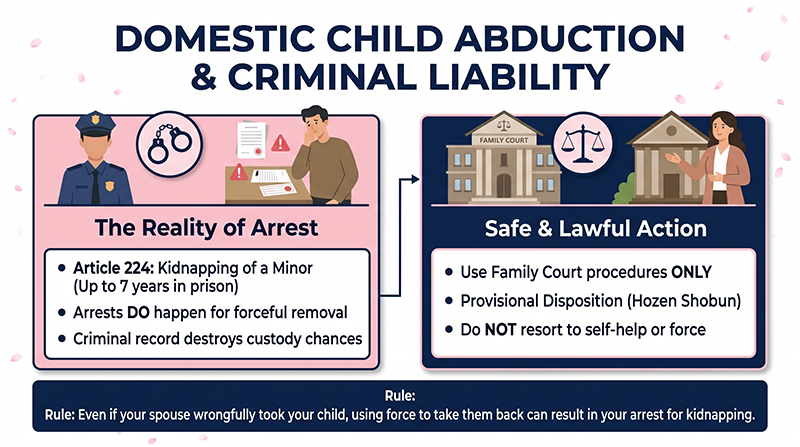
Warning: You must NEVER do this. Using “self-help” (Jiryoku Kyūsai) to forcefully take your child back is a crime in Japan.
Under Article 224 of the Japanese Penal Code, kidnapping a minor is a serious offense punishable by up to 7 years in prison.
- The Legal Precedent: Even if you possess joint parental authority, and even if your spouse wrongfully took the child first, the Japanese Supreme Court has repeatedly ruled that a parent who forcibly removes a child from the other parent’s peaceful custody can be arrested and convicted of kidnapping.
- The Consequences: Arrests for parental kidnapping happen frequently in Japan. If you are arrested for this, your chances of ever winning legal custody in the Family Court drop to near zero.
The Heavily Criticized Legal Paradox Foreign clients are often furious to learn this reality. There is a deeply criticized paradox in Japanese law: when your spouse initially takes the child from the marital home, the police treat it as a “civil family matter” and do not arrest them. But the moment you try to forcefully take the child back, you face criminal kidnapping charges. You must navigate this unfair double standard by relying strictly on the courts.
3. How Japanese Courts Actually Judge Removal: The “Primary Caregiver” Rule
A common misconception among expats is that Japanese courts blindly reward whoever takes the child first under the “Continuity of Care Principle” (Kangō no Keizokusei). In reality, Family Court judges look first at who the Primary Caregiver (Shutaru Kangosha) was prior to the separation.
- Removal by the Primary Caregiver: If the parent who handled the child’s day-to-day care (meals, school runs, medical care) leaves the marital home with the child, courts generally view this as a lawful exercise of their ongoing duty of care, rather than an illegal abduction.
- When the Court Orders a Return: Even if the primary caregiver took the child, the court will strip them of custody and designate the left-behind parent as custodian if the post-removal care environment is substandard or harmful to the child.
- Violent or Forceful Abductions: If a parent uses physical violence or force to snatch the child away, judges view the act as highly unlawful and are far more likely to issue an immediate Child Handover Order (Ko no Hikiwatashi) in favor of the left-behind parent.
4. The Legal Solution: The 3-Part Family Court Petition
To legally recover your child, your attorney must immediately file a combination of three aggressive legal maneuvers at the Family Court:
1. Petition for Designation of Custodian (Kangōsha Shitei) You ask the court to legally designate you as the primary physical custodian of the child.
2. Petition for the Handover of the Child (Ko no Hikiwatashi) You ask the court to formally order your spouse to return the child to you.
3. Urgent Provisional Disposition (Hozen Shobun) This is the most critical step. A standard court case takes months. An Urgent Provisional Disposition asks the judge to issue a temporary, emergency order to return the child immediately while the main case is being argued.
To win this provisional order, your attorney must prove that leaving the child with the other parent poses an imminent risk to the child’s health, safety, or emotional well-being, or that the removal was violently illegal.
5. Exceptions: Fleeing Domestic Violence (DV)
Not all departures with a child are classified as illegal abductions. If a parent takes a child and leaves the marital home to escape physical violence or severe emotional abuse (DV), the courts recognize this as a legitimate evacuation.
Under the 2026 Civil Code revisions (which emphasize mutual cooperation between parents), fleeing a dangerous environment to protect oneself and the child is explicitly excluded from being judged as a “violation of parental cooperation duties”.
- The DV Support Measure Trap: Unfortunately, some spouses falsely claim DV to justify an abduction and utilize administrative “DV Support Measures” (DV Tō Shien Sochi) to hide their new address. If you are falsely accused, your attorney can use Bar Association Inquiries (Bengoshikai Shōkai) or Court Investigation Orders to uncover the address and initiate the custody legal battle.
About the Author & Reviewer
Eriko Matsuno, Attorney at Law — Tokyo J Law Office Last Updated: November 2026
With over 25 years of experience, Attorney Eriko Matsuno provides rapid, aggressive legal intervention in domestic child abduction cases. She is highly experienced in securing Urgent Provisional Dispositions (Hozen Shobun) to recover children, while carefully guiding international parents to avoid criminal traps like kidnapping charges.
Has your spouse taken your child, or are you planning to leave a dangerous home? Time is your enemy. Our office provides immediate legal representation in English. ➡️ Contact Us for an Urgent Consultation
Frequently Asked Questions (FAQ)
A: The police will generally not help you physically retrieve the child unless the child is in immediate physical danger. Going there and attempting to force your way in or grab the child can result in your arrest for assault or parental kidnapping. Contact a lawyer to file a Family Court petition immediately.
A: If your spouse ignores the court order, you can apply for Compulsory Execution (Kyōsei Shikkō). First, the court can impose daily financial fines (Kansetsu Kyōsei). If that fails, a court bailiff (Shikkōkan) can be sent to physically take the child, though this is a highly sensitive and strictly regulated procedure.
A: Practically, you cannot physically restrain an adult from leaving the house. If you suspect they are planning to leave with the children, document everything, maintain a heavy presence in the child’s daily care (to prove you are the primary caregiver), and consult an attorney about pre-emptive legal strategies.
