When an Heir Is a Foreign National: What Changes in a Japanese Inheritance
By Eriko Matsuno, Attorney at Law — Tokyo J Law Office
Perhaps a sibling took another nationality after marrying abroad. Or one of the heirs is a foreign national who has never lived in Japan. Situations like these are not unusual. This article explains what changes, and what stays the same, when one of the heirs is not a Japanese national.
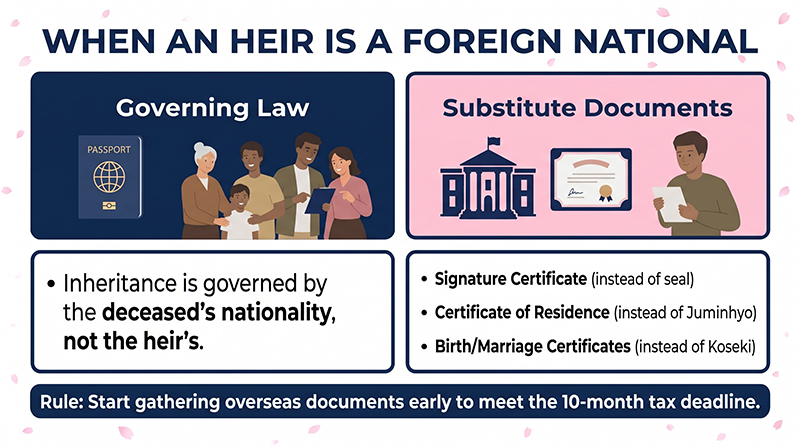
1. The governing law follows the deceased’s nationality, not the heirs’
This is one of the most common misconceptions. The law that governs an inheritance is determined by the nationality of the person who died, not by the nationality of the heirs (Article 36, Act on General Rules for Application of Laws).
- If the deceased was Japanese: Japanese law governs the inheritance, even if some of the heirs are foreign nationals. The Civil Code decides who inherits and in what shares, exactly as it would for any other Japanese estate.
- If the deceased was a foreign national: the law of the deceased’s home country applies in principle. But if that law points back to Japanese law, for example by applying the law of the place where real estate is located, or by applying Japanese law to someone domiciled in Japan, Japanese law may apply in the end. This is known as renvoi (Article 41 of the same Act).
In short, an heir’s foreign nationality does not by itself bring foreign law into play. The first step is always to confirm the nationality of the deceased.
2. Japanese law may apply, but the paperwork is different
Even when Japanese law governs, as where the deceased was Japanese and only one heir holds a foreign nationality, having a foreign heir changes how several procedures work in practice.
No seal certificate: a signature certificate instead
A Japanese estate division agreement is normally stamped with each heir’s registered seal (jitsuin) and accompanied by a seal registration certificate. Heirs from countries without a seal registration system, and Japanese nationals abroad who have no registered seal in Japan, cannot provide one.
They use a signature certificate (shomei shomeisho) instead. This official document confirms that a signature is genuinely that of the person concerned. In Japan, a notary office can issue it; heirs living abroad can obtain one from the local Japanese embassy or consulate.
No resident record: a certificate of residence instead
Heirs who live abroad often have no Japanese resident record (juminhyo). A certificate of residence (zairyu shomeisho) issued by a Japanese embassy or consulate takes its place.
No family register
Foreign nationals are outside Japan’s family register (koseki) system, so no family register exists for them. Family relationships are instead proved with documents issued by their own country, such as birth and marriage certificates, translated into Japanese where required.
3. Don’t overlook inheritance tax
An heir who is a foreign national or lives abroad can still be liable for Japanese inheritance tax. Whether the tax reaches worldwide assets or only assets in Japan depends on a detailed set of rules based on the nationality and residence of both the heir and the deceased.
Getting this wrong can result in assets going unreported. In this area, working with a tax accountant experienced in cross-border inheritance is essential.
4. Practical tips
Build in extra time for documents
Signature certificates and certificates of residence have to be obtained through an embassy or consulate, which takes longer than a purely domestic procedure. With deadlines such as the ten-month limit for filing the inheritance tax return in mind, start gathering documents as soon as you know that one of the heirs is a foreign national.
Language barriers go deeper than translation
Translating the documents is not enough for a foreign heir to understand an estate division agreement properly. The underlying concepts of Japanese inheritance law, such as statutory shares and the forced share (iryubun), also need to be explained. Heirs from countries whose systems work on different assumptions may otherwise object later that they “never knew such a rule existed.”
A lawyer as a single point of contact makes cross-border matters far easier
Time differences, dealings with embassies and consulates, and, where needed, coordination with lawyers abroad can be a heavy burden for families handling things on their own. Having a lawyer with international experience act as the single point of contact keeps the process moving smoothly.
5. Summary
If the deceased was Japanese, the inheritance is governed by Japanese law even when one of the heirs is a foreign national. In practice, though, such cases call for steps a purely domestic inheritance does not: substitute documents for the seal certificate and family register, and a careful look at how far inheritance tax reaches. Where an inheritance has an international element, we recommend speaking to a lawyer with cross-border experience early on.
