Divorce Litigation (Saiban Rikon) in Japan: The Family Court Process
By Eriko Matsuno, Attorney at Law — Tokyo J Law Office
For expats facing the end of a marriage in Japan, the legal process can be confusing. Many foreign nationals assume that if their spouse refuses to sign divorce papers, the next immediate step is to “sue them for divorce” in court [cite: 1].
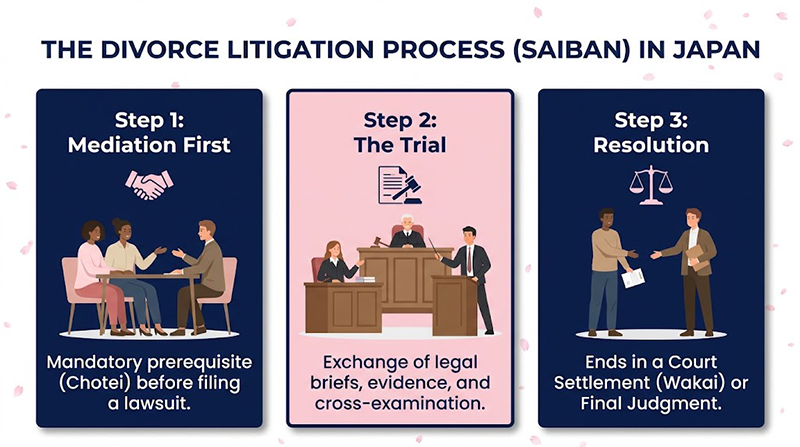
However, the Japanese legal system does not allow you to jump straight into litigation. Japan operates on a strict “Mediation-First Principle” (Chōtei Chichi Shugi). You can only file a divorce lawsuit (Saiban Rikon) if Family Court Mediation (Chōtei) has officially failed.
If mediation fails, litigation is the final battleground. This guide explains the step-by-step process of a Japanese divorce lawsuit, what you need to prove, and how the court reaches a resolution [cite: 1].
Contents
- The Prerequisite: Mediation First
- Legal Grounds for Divorce (Civil Code Art. 770)
- Step-by-Step: The Litigation Process
- Cross-Examination (Jinmon)
- Court-Recommended Settlement (Wakai) vs. Judgment
- Why You Need an Experienced Attorney
1. The Prerequisite: Mediation First (Chōtei Chichi Shugi)
Under Japanese law, family disputes must prioritize amicable resolution. Before you can file a lawsuit, you must file for Divorce Mediation (Fūfu Kankei Chōsei Chōtei) at the Family Court.
Only when the mediation committee officially declares that the mediation has failed (Chōtei Fuseiritsu)—meaning the parties absolutely cannot reach an agreement on the divorce itself, child custody, or financial terms—are you legally permitted to file a formal divorce lawsuit.
2. Legal Grounds for Divorce (Civil Code Art. 770)
In mediation, you can divorce for any reason as long as both parties agree. In a lawsuit, however, the judge will only grant a divorce if you can prove one of the five legal grounds specified in Article 770 of the Civil Code [cite: 1]:
- Infidelity / Adultery (Futei Kōi): Your spouse had sexual relations outside the marriage.
- Malicious Abandonment (Akui no Iki): Your spouse refused to live together, cooperate, or share living expenses without a valid reason.
- Missing for 3+ Years: It has been unknown whether your spouse is dead or alive for over three years.
- Severe Mental Illness: Your spouse has a severe mental disease with no prospect of recovery.
- Grave Cause Making Marriage Continuation Impossible: A catch-all category that includes severe domestic violence (DV), extreme emotional abuse (moral harassment), or a long-term physical separation (usually 3 to 5+ years) that demonstrates the marriage is completely and irreparably broken.
Evidence is Everything: You cannot simply state that your spouse cheated or abused you. You must provide objective, hard evidence (photos, emails, medical certificates, audio recordings, or financial records) [cite: 1].
3. Step-by-Step: The Litigation Process
If you have legal grounds and evidence, your attorney will guide you through the following phases [cite: 1]:
1. Filing the Complaint (Sojō): Your attorney drafts a formal complaint outlining the legal grounds for divorce, along with your demands for child custody, property division, child support, and alimony (Isharyō) [cite: 1]. This is filed at the Family Court with jurisdiction over the defendant’s address [cite: 1].
2. The Defendant’s Answer (Tōbensho): The court serves the complaint to your spouse (the Defendant), who must submit a written Answer admitting or denying your claims before the first hearing [cite: 1].
3. Preparatory Proceedings (Benron Junbi Tetsuzuki): Instead of dramatic open-court hearings, most of the lawsuit takes place in private conference rooms (or via web conferences) [cite: 1]. Every month, the attorneys exchange written briefs and documentary evidence to clarify the contested issues (e.g., arguing over the valuation of a house or proving infidelity) [cite: 1]. This phase can last from 6 months to over a year [cite: 1].
4. Cross-Examination (Jinmon)
Once all written arguments and evidence have been submitted, the court schedules the Examination of Parties (Tōjisha Jinmon) [cite: 1].
This is the climax of the trial, held in an open courtroom [cite: 1]. Both spouses (and occasionally witnesses, though rare in divorce cases) will take the stand [cite: 1].
- First, your own attorney will ask you questions to highlight your side of the story [cite: 1].
- Next, your spouse’s attorney will aggressively cross-examine you to expose inconsistencies in your testimony [cite: 1].
- Finally, the judge may ask supplementary questions [cite: 1].
The entire examination typically lasts about 2.5 hours [cite: 1].
5. Court-Recommended Settlement (Wakai) vs. Judgment
After the cross-examination, the judge has usually formed an opinion on how they will rule. At this stage, Japanese judges highly prefer that the parties settle rather than forcing a final judgment.
Court-Recommended Settlement (Wakai Kankoku): The judge will present a proposed settlement plan [cite: 1]. For example, the judge might say, “I am going to rule that the divorce is granted and order 2 million JPY in alimony. However, if you agree to settle now, we can resolve it without a public judgment.” If both parties agree, a Settlement Record (Wakai Chōsho) is created, and the lawsuit ends immediately [cite: 1].
Final Judgment (Hanketsu): If the parties refuse the settlement, the judge will issue a formal Judgment roughly 1 to 3 months later [cite: 1]. The losing party has two weeks to file an appeal to the High Court [cite: 1]. If no appeal is filed, the judgment becomes final (Kakutei), and the divorce is legally binding [cite: 1].
6. Why You Need an Experienced Attorney
Divorce litigation is fundamentally different from mediation [cite: 1]. Mediation is a facilitated discussion; litigation is a rigid legal procedure governed by the Code of Civil Procedure.
A pro se litigant (representing yourself) is at a severe disadvantage, especially if your Japanese is not fluent. Drafting legal briefs, gathering admissible evidence, and surviving cross-examination requires the strategic accompaniment (bansō) of a seasoned litigator [cite: 1]. Furthermore, a long trial takes a significant mental toll; having a dedicated attorney protects your mental well-being and ensures your financial future is fiercely defended [cite: 1].
About the Author & Reviewer
Eriko Matsuno, Attorney at Law — Tokyo J Law Office Last Updated: November 2026
With over 25 years of experience handling complex international divorces, Attorney Eriko Matsuno provides robust courtroom representation for expats in Japan. She leverages her extensive litigation background to build airtight evidentiary cases and strategically negotiate favorable court settlements.
Are you facing a divorce lawsuit in Japan? Litigation requires immediate, strategic action. Our office provides full representation in English. ➡️ Contact Us for a Consultation
Frequently Asked Questions (FAQ)
A: No. If you ignore the court summons and fail to submit an Answer (Tōbensho), the judge will automatically rule in favor of your spouse, granting them everything they asked for in the complaint [cite: 1]. You must retain an attorney to respond.
A: From the filing of the complaint to the final judgment, a standard divorce lawsuit takes about 1 to 1.5 years. If the case is appealed to the High Court, it can take an additional 6 months or more.
A: No. All Japanese court proceedings and documents must be in Japanese. If you take the stand for cross-examination, the court will appoint an official interpreter so you can testify in English, but all written briefs and evidence submitted by your attorney must be translated into Japanese.
