Child Support and Alimony (Isharyo) in Japan: What International Couples Must Know
By Eriko Matsuno, Attorney at Law — Tokyo J Law Office
When expats and international couples divorce in Japan, they are often shocked by how differently Japanese Family Courts handle financial support compared to courts in the US, UK, or Europe.
Many foreigners mistakenly believe they are automatically entitled to long-term “spousal maintenance” just because their spouse earns more. Others assume that private international school tuition will automatically be covered by standard child support.
Under Japanese law, Child Support (Yōikuhi) and Alimony (Isharyō) operate under strict, formulaic guidelines. For high-net-worth individuals, executives, and families with unique expenses, simply relying on basic court tables will lead to significant financial disadvantage. This guide explains how to navigate financial support in a Japanese international divorce.
Contents
- Why is Child Support Paid in Japan? (The Duty to Support)
- Child Support (Yōikuhi): The Standard Calculation Tables
- High-Income Earners: Breaking the 20 Million Yen Cap
- International School Tuition and Extracurriculars
- The 2026 Statutory Child Support Warning
- Alimony / Solatium (Isharyō): The Fault-Based System
- Securing Payment: The Power of a Notarized Deed
1. Why is Child Support Paid in Japan? (The Duty to Support)
Under Japanese Civil Code Article 877, lineal blood relatives (such as parents and children) have a legal obligation to support each other. Therefore, even after a divorce, both parents retain the legal duty to support their child financially, regardless of who holds parental authority (Shinken).
- Who Pays Whom? Legally, child support is paid by the non-custodial parent to the parent who physically resides with and cares for the child (Kangosha). While some paying parents wish to pay the child directly, or pay tuition directly to the school, the legal right to claim and receive child support generally belongs to the custodial parent.
- No Automatic Wage Garnishment: Unlike in the US, where child support can be automatically deducted from a paycheck by a state agency, Japan relies heavily on voluntary compliance unless you secure a legally enforceable document (discussed in Section 7).
2. Child Support (Yōikuhi): The Standard Calculation Tables
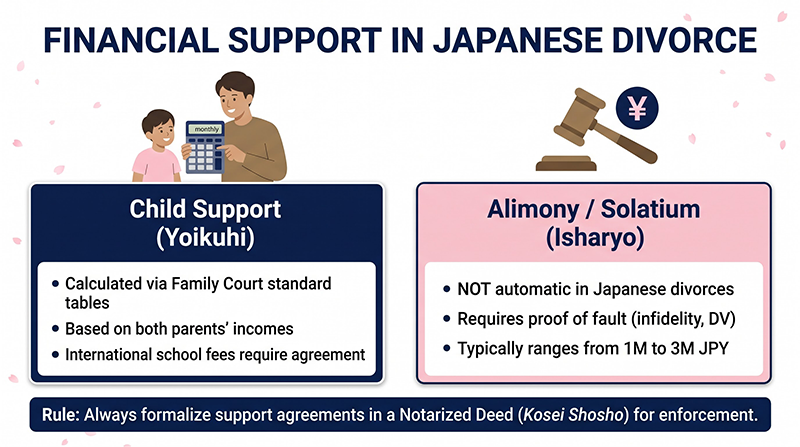
In Japan, child support is not randomly decided by a judge. It is calculated using the Standard Calculation Tables (Santeihyō) published by the Supreme Court of Japan.
The formula is based primarily on three factors:
- The gross annual income of the paying parent (Obligor).
- The gross annual income of the receiving parent (Obligee).
- The number and ages of the children (ages 0–14, and 15+).
These tables are designed to ensure that the child maintains the same standard of living they would have had if the parents had not divorced. However, the tables assume a standard Japanese public school education and standard domestic living expenses.
3. High-Income Earners: Breaking the 20 Million Yen Cap
A major issue for expat executives and business owners is that the Japanese Standard Calculation Tables max out at an annual income of 20 million JPY.
If the paying parent earns 40 million or 100 million JPY, does child support cap at the 20 million mark?
- The Legal Reality: Courts do not automatically scale up child support proportionally for ultra-high earners. Instead, specialized attorneys must argue for customized calculations—often using a modified formula that factors in the actual high savings rate of wealthy households.
- Without aggressive legal representation, a high-earning spouse might only be ordered to pay the standard capped amount, leaving the custodial parent struggling to maintain the child’s previous lifestyle.
4. International School Tuition and Extracurriculars
One of the most fiercely contested issues in international divorces in Japan is the cost of private international schools.
Are international school fees included in standard child support? No. The standard tables only account for standard Japanese public school expenses.
Can I force my ex-spouse to pay for international school? A Japanese Family Court will generally only order a parent to pay for expensive international or private schooling if:
- Both parents explicitly agreed to send the child to that school prior to the divorce; or
- The paying parent’s income and social standing make attending such a school standard and expected; or
- The child has already been attending the school, and transferring them would cause significant educational or psychological disruption.
These costs are usually calculated as an “addition” to the base child support. It is critical to secure this agreement in writing during mediation.
5. The 2026 Statutory Child Support Warning
As part of the April 2026 Civil Code revision, Japan introduced a “Statutory Child Support” (Hōtei Yōikuhi) system. This allows a custodial parent to claim child support even if no formal agreement was made at the time of divorce.
Warning for Expats: Do not rely on this default system. The statutory baseline amount is set extremely low (e.g., approximately 20,000 JPY per month per child). It is meant as a bare-minimum emergency safety net, not a substitute for a proper calculation. You must negotiate and formalize a realistic child support amount before finalizing your divorce.
6. Alimony / Solatium (Isharyō): The Fault-Based System
In many Western jurisdictions, “alimony” or “spousal maintenance” is paid to balance the post-divorce income disparity between spouses, regardless of whose fault the divorce was.
Japan does not have a no-fault spousal maintenance system. In Japan, alimony is called Isharyō, which translates strictly to Solatium (compensation for emotional distress).
You are only entitled to Isharyō if you can prove that the marriage broke down due to the illegal or malicious fault of your spouse.
- Valid Grounds for Isharyō: Infidelity (adultery), physical domestic violence (DV), severe psychological abuse, or “malicious abandonment” (e.g., kicking you out of the house and cutting off all financial support).
- Invalid Grounds: “Growing apart,” “personality differences,” or “falling out of love.” If neither party is legally at fault, zero Isharyō is paid.
How much is Isharyō in Japan? Compared to multi-million dollar settlements in the US or UK, Japanese Isharyō is quite low. For infidelity or DV leading to divorce, the market rate typically ranges from 1 million to 3 million JPY. It rarely exceeds 5 million JPY unless the circumstances are exceptionally egregious.
7. Securing Payment: The Power of a Notarized Deed
Whether you are agreeing to 100,000 JPY a month in child support, sharing international school tuition, or receiving 3 million JPY in Isharyō, a verbal promise or a signed piece of paper is not enough.
If the paying spouse stops paying, you cannot easily garnish their wages unless you have an Enforceable Notarized Deed (Shikkō Nindaku Yakkan-tsuki Kōsei Shōsho) or a Family Court Mediation Record (Chōtei Chōsho).
Drafting these documents requires precise legal Japanese. Before submitting a divorce registration (Rikon Todoke) to the city hall, consult an international family lawyer to legally lock in your financial future.
About the Author & Reviewer
Eriko Matsuno, Attorney at Law — Tokyo J Law Office Last Updated: November 2026
With over 25 years of legal experience, Attorney Eriko Matsuno specializes in securing fair financial outcomes for expats, executives, and international families in Japan. She possesses deep expertise in calculating child support for high-net-worth individuals and negotiating complex Isharyō claims.
Need help calculating child support or claiming alimony in Japan? Our office provides consultations in English for clients living in Japan and overseas (online consultations via Zoom/Teams available). ➡️ Contact Us for a Consultation
Frequently Asked Questions (FAQ)
A: Yes. Moving overseas does not extinguish the legal obligation to pay child support. However, depending on the cost of living in the new country and exchange rate fluctuations, the amount can sometimes be modified through the Family Court.
A: Yes. Under Japanese law, if your spouse committed adultery, you have the right to sue both your spouse and the third-party affair partner for Isharyō.
A: Child support is typically paid until the child reaches the age of 20 (the traditional age of majority, often tied to graduation from high school or entering the workforce) or until age 22 if the child attends a 4-year university, depending on what the parents agree upon or the court orders.
