Marital Expenses (Kon’in Hiyo): Securing Financial Support During Separation in Japan
By Eriko Matsuno, Attorney at Law — Tokyo J Law Office
One of the most common sources of anxiety when a marriage breaks down is financial survival during the separation period. A dependent spouse (often a homemaker or part-time worker) may fear leaving the marital home because they have no income.
In Japan, you do not have to wait until the divorce is finalized to receive financial support. Even if you are living apart, as long as you are legally married, the higher-earning spouse has a strict legal obligation to support the lower-earning spouse. This pre-divorce financial support is called Marital Expenses (Kon’in Hiyō).
This guide explains what Kon’in Hiyo covers, when to claim it, and how to protect yourself if your spouse refuses to pay.
Contents
- What is Kon’in Hiyo (Marital Expenses)?
- When Can You Claim Marital Expenses?
- Exceptions: When is a Claim Denied?
- The Golden Rule: Claim Immediately (No Retroactive Payments)
- How is the Amount Determined?
- Three Steps to Claim Kon’in Hiyo
- Frequently Asked Questions (FAQ)
1. What is Kon’in Hiyo (Marital Expenses)?
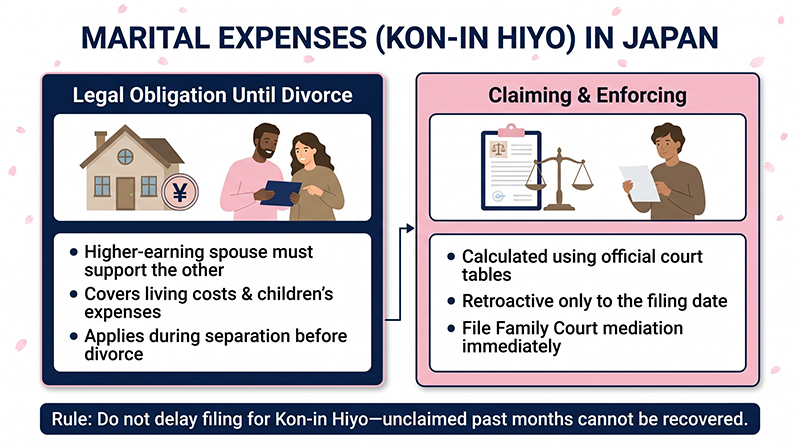
Kon’in Hiyo refers to the living expenses that spouses are legally required to share based on their respective incomes while they are still married.
It is broader than standard child support. Kon’in Hiyo includes:
- Spousal Support: Daily living expenses for the dependent spouse (food, utilities, rent).
- Child Support: Expenses for raising and educating the children, including medical costs.
The Difference Between Kon’in Hiyo and Child Support (Yōikuhi) It is crucial to distinguish between these two terms. Kon’in Hiyo is paid before the divorce is finalized and covers both the spouse and the children. Yōikuhi (Child Support) is paid after the divorce is finalized and is strictly for the support of the children.
2. When Can You Claim Marital Expenses?
You can claim Kon’in Hiyo when the higher-earning spouse refuses to pay living expenses, or when you cannot agree on a fair amount.
Common Scenarios:
- During Separation: Your spouse cannot legally say, “We are getting divorced, so I am not paying your rent anymore”. Until the divorce is officially registered, the duty to support remains.
- While Living Together: Even if you still live under the same roof, if the primary earner cuts off your access to funds or refuses to provide adequate living expenses, you can legally demand Kon’in Hiyo.
A Warning on Verbal Agreements: If you verbally agree to a very low amount just to avoid conflict, it is extremely difficult to increase that amount later. Always consult a specialized attorney before agreeing to a figure.
3. Exceptions: When is a Claim Denied?
While the right to Kon’in Hiyo is strong, there are exceptional circumstances where the Family Court will reduce or deny the claim:
- You Caused the Separation (Fault): If the claiming spouse is the primary cause of the marital breakdown (e.g., you committed infidelity or domestic violence and subsequently moved out), the court will generally not order the other spouse to pay your living expenses. However, if you took the children with you, the court will still order payment for the children’s living expenses, as child support is a fundamental right of the child.
- Cohabiting with an Affair Partner: If you are living with a romantic partner who is providing you with financial support, your claim for spousal living expenses will be heavily discounted or denied.
- Refusing to Work: If you have qualifications and are physically and mentally capable of working, but you simply refuse to get a job to rely entirely on your spouse, the court may impute a hypothetical income to you. (Continuing a pre-existing part-time job is generally acceptable, but if you claim you cannot work at all, you will need medical certificates to prove it.)
4. The Golden Rule: Claim Immediately (No Retroactive Payments)
The most critical rule of Kon’in Hiyo is that it is generally calculated from the month you formally make the claim, not the date you separated.
If you separate in January, but wait until June to formally demand Kon’in Hiyo through a lawyer or the court, you generally cannot claim the unpaid expenses for February through May. (In some limited cases, past unpaid expenses might be factored into the final property division at divorce, but court rulings on this are strict and unpredictable.)
Therefore, the moment you separate—or the moment your spouse cuts off your finances—you must initiate a formal claim.
5. How is the Amount Determined?
The amount is calculated based on the gross incomes of both spouses and the number/ages of the children. Just like post-divorce child support, the Family Court uses standard calculation tables to determine a baseline figure.
However, for high-net-worth expat families, these tables are often insufficient. Special educational expenses (like private international school tuition) or high medical costs must be specifically argued and proven as “special additions” to the baseline amount.
6. Three Steps to Claim Kon’in Hiyo
If your spouse is not providing adequate support, take these steps:
Step 1: Direct Negotiation and a Notarized Deed
Ideally, spouses should discuss and agree on a monthly amount. Once agreed, you must memorialize this in a Notarized Deed (Kōsei Shōsho) that includes a “mandatory execution clause” (Kyōsei Shikkō Nindaku Jōkō). If your spouse stops paying, this deed allows you to bypass a lawsuit and immediately garnish their salary or bank accounts.
Step 2: Content-Certified Mail (Naiyō Shōmei)
If your spouse ignores your texts or refuses to discuss finances, your lawyer will send a formal demand letter via Content-Certified Mail. This provides official postal proof of the exact date you made your claim, securing your right to payments from that month forward.
Step 3: File for Family Court Mediation (Chōtei)
If your spouse still refuses to pay or agree to a fair amount, you must file a Petition for Conciliation of Marital Expenses (Kon’in Hiyō Buntan Seikyū Chōtei).
- Jurisdiction: You must file this at the Family Court that has jurisdiction over your spouse’s residential address, not yours.
- Required Documents: You will need proof of your income and your spouse’s income (such as tax withholding slips [Gensen Chōshū Hyō] or recent pay stubs). If you have children, bring proof of special expenses like tuition or medical bills.
- The Process: A male and female mediation committee will facilitate the discussion. If an agreement is reached, it is recorded in a binding Court Mediation Record (Chōtei Chōsho), which carries the same enforcement power as a court judgment.
About the Author & Reviewer
Eriko Matsuno, Attorney at Law — Tokyo J Law Office Last Updated: November 2026
With over 25 years of legal experience, Attorney Eriko Matsuno is highly skilled at securing immediate financial stability for spouses navigating separation and divorce. By filing rapid claims for Kon’in Hiyo and utilizing Family Court Mediation, she ensures her clients are not starved into accepting an unfair divorce settlement.
Has your spouse cut off your finances or refused to pay living expenses? Do not wait. Our office provides rapid legal intervention in English to secure your marital expenses. ➡️ Contact Us for an Urgent Consultation
