The “At-Fault Spouse” (Yūseki Haigūsha) in Japan: Can You Still Get a Divorce?
By Eriko Matsuno, Attorney at Law — Tokyo J Law Office
If you are considering a divorce in Japan, you may have heard a terrifying rumor: “If you are the one who cheated or caused the marriage to fail, you are legally forbidden from getting a divorce.”
Unlike in many Western countries where “no-fault divorce” allows either party to end the marriage at will, Japanese Family Law maintains a strict, traditional doctrine. Under Japanese Supreme Court precedents, a spouse who destroys the marriage through their own illegal or malicious actions is classified as a “Yūseki Haigūsha” (At-Fault Spouse) .
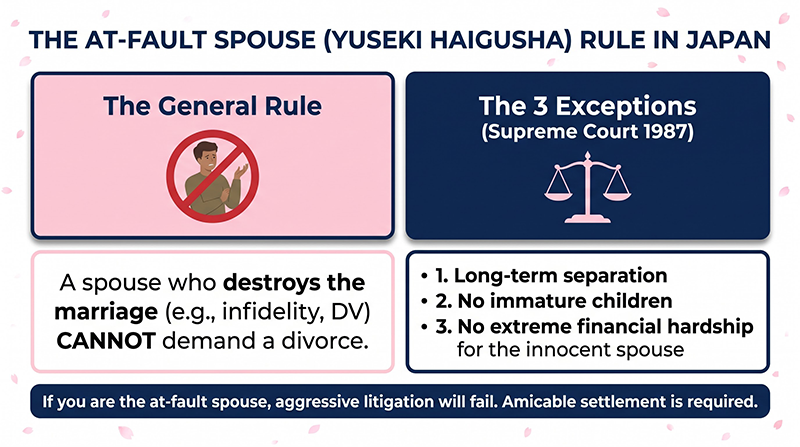
As a general rule, an at-fault spouse cannot demand a divorce against the will of the innocent spouse. This guide explains what actions make you an at-fault spouse, the historical Supreme Court rulings that govern this rule, and the three strict exceptions where a divorce may still be granted.
Contents
- What Makes You an “At-Fault Spouse”?
- The General Rule: No Reward for Bad Behavior
- The 3 Exceptions: The 1987 Supreme Court Ruling
- Strategic Advice for the At-Fault Spouse
- Frequently Asked Questions (FAQ)
1. What Makes You an “At-Fault Spouse”?
You do not automatically become an at-fault spouse just because your partner blames you for the end of the relationship. The court strictly defines this based on objective acts that violate the legal duties of marriage.
The primary grounds for being classified as a Yūseki Haigūsha include:
- Infidelity (Futei Kōi): Having a sexual relationship with someone other than your spouse. This is the most common reason for being labeled at-fault.
- Malicious Abandonment (Akui no Iki): Refusing to live together, cooperate, or financially support your spouse without a justifiable reason (e.g., abandoning a financially dependent spouse and refusing to pay living expenses).
- Domestic Violence and Moral Harassment: Subjecting your spouse to physical violence, severe psychological abuse, or extreme controlling behavior that destroys the marital bond.
2. The General Rule: No Reward for Bad Behavior
The foundation of the at-fault spouse doctrine comes from a famous 1952 Supreme Court ruling (often called the “Fumdari Kettari” or “Adding Insult to Injury” ruling).
In that case, a husband who was living with his mistress tried to force a divorce upon his legal wife. The Supreme Court famously dismissed his request, stating that granting a divorce to a spouse who selfishly destroyed the marriage would be completely immoral and leave the innocent wife in a devastating position.
Therefore, if you are the at-fault spouse and you file a divorce lawsuit in a Japanese Family Court, the judge will generally dismiss your claim if your spouse refuses to divorce you. Your spouse can legally force you to remain married to them.
3. The 3 Exceptions: The 1987 Supreme Court Ruling
For decades, the 1952 ruling meant that at-fault spouses were permanently trapped in marriages. However, in 1987, the Supreme Court recognized that forcing a completely shattered marriage to exist on paper forever was also unrealistic.
The court established that an at-fault spouse can be granted a divorce by the court, but only if all three of the following strict conditions are met:
- Long-Term Separation: The couple has been separated for a substantially long time relative to their ages and the length of their cohabitation. (In modern practice, this usually means a separation of at least 7 to 10 years, though it varies heavily depending on the case).
- No Immature Children (Miseijukushi): The couple does not have any young children who are still socially and financially dependent (typically, the children must have reached adulthood or financial independence).
- No Extreme Hardship for the Innocent Spouse: Granting the divorce must not place the innocent spouse in an extremely harsh mental, social, or economic condition. (e.g., if the innocent spouse is elderly, ill, and will be left destitute without the at-fault spouse’s financial support, the divorce will be denied).
Unless you meet all three of these criteria, the court will not force a divorce upon an unwilling innocent spouse.
4. Strategic Advice for the At-Fault Spouse
If you are an at-fault spouse, filing an aggressive divorce lawsuit is a guaranteed way to lose. Because the court will likely dismiss your case, your only viable path to a divorce is amicable settlement (Kyōgi Rikon or Chōtei Rikon).
To secure a divorce, you must negotiate directly or through mediation, and you must convince your spouse to voluntarily agree to sign the divorce papers.
In practice, this means the at-fault spouse must often pay a substantial premium to “buy” their way out of the marriage. This usually includes:
- Paying higher Alimony / Solatium (Isharyō).
- Conceding a larger share of the Property Division (Zaisan Bunyo).
- Paying generous child support.
Without an experienced attorney to tactfully manage these negotiations, your spouse may dig in their heels and refuse to divorce you indefinitely.
About the Author & Reviewer
Eriko Matsuno, Attorney at Law — Tokyo J Law Office Last Updated: November 2026
With over 25 years of legal experience, Attorney Eriko Matsuno is highly skilled at navigating the complex emotional and legal barriers of high-conflict divorces. Whether you are an innocent spouse looking to block an unfair divorce, or an at-fault spouse seeking a negotiated exit from a broken marriage, she provides discreet, strategic counsel.
Are you trapped in a high-conflict marriage? Our office provides strategic legal intervention in English to help you negotiate a realistic settlement. ➡️ Contact Us for a Consultation
Frequently Asked Questions (FAQ)
A: Not necessarily. If your spouse’s abuse had already fundamentally broken the marriage before your infidelity occurred, the court might not classify you as the sole at-fault spouse. Establishing the timeline of when the marriage actually “broke down” is critical in these cases.
A: Yes. If you have proof of his infidelity and you refuse to consent to the divorce, his divorce lawsuit will be dismissed as long as the three exceptions (like a 10-year separation) are not met. During this time, he is still legally required to pay your living expenses (Kon’in Hiyo).
